

Buyer’s Market or Seller’s Market? Here’s How To Tell Where You Stand
A few years ago this question barely mattered. It was a seller’s market almost everywhere, full stop. That is no longer true, and the honest answer now depends entirely on where you live.
The Power Has Shifted, But Not Evenly
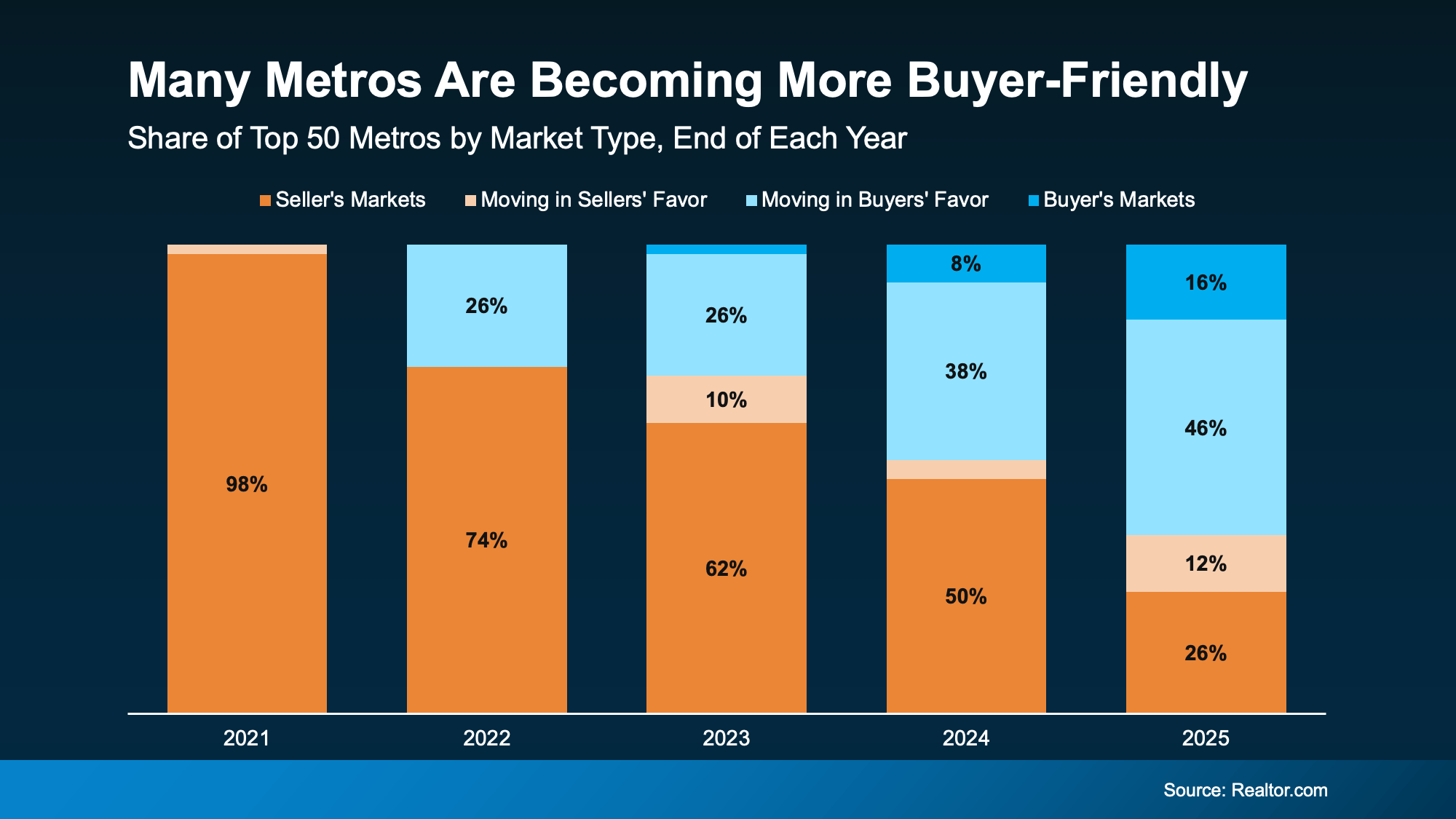
Realtor.com’s new Market Clock tool gives the clearest national snapshot available right now. Of the 50 largest U.S. metros, only 13, just 26%, remain seller’s markets. Another 23 sit in a “balanced-loosening” phase, meaning they are still even but drifting toward buyers. Eight are outright buyer’s markets. And a small group, 6 metros, are actually tightening back toward sellers, which shows this is not a one-way national trend so much as dozens of local stories moving in different directions at once.
Compare that to 2021, when nearly every major metro favored sellers, and the shift is obvious. But “the market has shifted” is not the same as “your market has shifted.” That distinction is where most of the confusion buyers and sellers run into right now actually comes from.
Why the Same Headline Means Different Things in Different Places
The honest driver behind all of this is supply. Markets that built aggressively over the past several years now have more inventory, more competition among sellers, and more leverage for buyers. Markets that did not build at the same pace are still tight, and tight inventory still means sellers hold the advantage there regardless of what the national headline says.
As Jeff Ostrowski, Housing Analyst at Bankrate, put it: the formerly hot Sun Belt markets have cooled while the Northeast and Midwest have stayed hot, and the big driver is construction activity. Markets that saw major building booms now carry a large supply of new and existing homes, which is exactly what is softening conditions in places like Austin, Tampa, and San Antonio. Markets that did not see that same construction wave, including much of the Northeast and Midwest, never got the inventory relief, so competition there has stayed fierce.
This is also why two people in two different cities can read the exact same “market has cooled” headline and have completely opposite experiences once they actually start shopping or listing.
Where That Leaves South Jersey
This is the part the national coverage almost never addresses, and it is the part that actually matters for your decision. The Northeast broadly has not seen the building boom that loosened markets in the Sun Belt, and that pattern holds in our area too. According to Zillow’s Home Value Index, Camden County homes are going to pending in around 18 days with values up 4.9% over the past year. That is not a market that has flipped to favor buyers. It is a market still leaning toward sellers in most segments, even while national coverage talks about buyers regaining ground elsewhere.
That regional gap is exactly why a generic national headline is the wrong thing to plan around. Our South Jersey Real Estate Market Update 2026 breaks down where Camden, Burlington, Gloucester, and Salem counties actually stand right now, county by county, and our Top Neighborhoods to Buy a Home in Camden County goes a level deeper, since even within the county the leverage shifts from one borough to the next.
If You’re Buying Where Sellers Still Have the Edge
In a tighter market like ours, preparation does most of the work. Get pre-approved, not just pre-qualified, before you start touring homes. We laid out exactly why that distinction matters in 4 Ways To Give Your Offer an Edge This Spring, along with the specific terms that make an offer stand out beyond just the price. Be ready to move quickly once you find the right home, and lean on your agent to structure the offer around what the seller actually cares about, not just the highest number you can stretch to.
If You’re Selling Where the Market Has Loosened
If your situation involves a market segment with more competition among sellers, the fundamentals do not change, they just matter more. Pricing correctly from day one is the single biggest lever you control, and we covered exactly why overpricing backfires in The Pricing Mistake That Could Cost You Your Sale. Presentation matters more too when buyers have options to compare against, which is why Why Staging Your House Could Pay Off This Spring is worth a serious look before you list.
The One Thing That Doesn’t Change
Whether your specific market favors buyers or sellers right now, the strategy that wins is the same: know the actual local data before you act, not the national average. A seller in a tight market can afford to hold a firmer line. A buyer in a loosening market has real room to negotiate. Getting that read wrong in either direction costs real money.
Reach out to the MH Global team. Let’s look at exactly where your specific neighborhood sits right now and build your strategy around that, not a national headline.