Why a Home That’s Been Sitting for Months Could Be Your Best Opportunity
Scroll through any home search right now and you’ll spot them immediately. Two months on market. Three months. Sometimes longer. The instinct is to assume something’s wrong and keep scrolling. That instinct is exactly what’s costing some buyers a real opportunity.
The Math Behind a Stale Listing
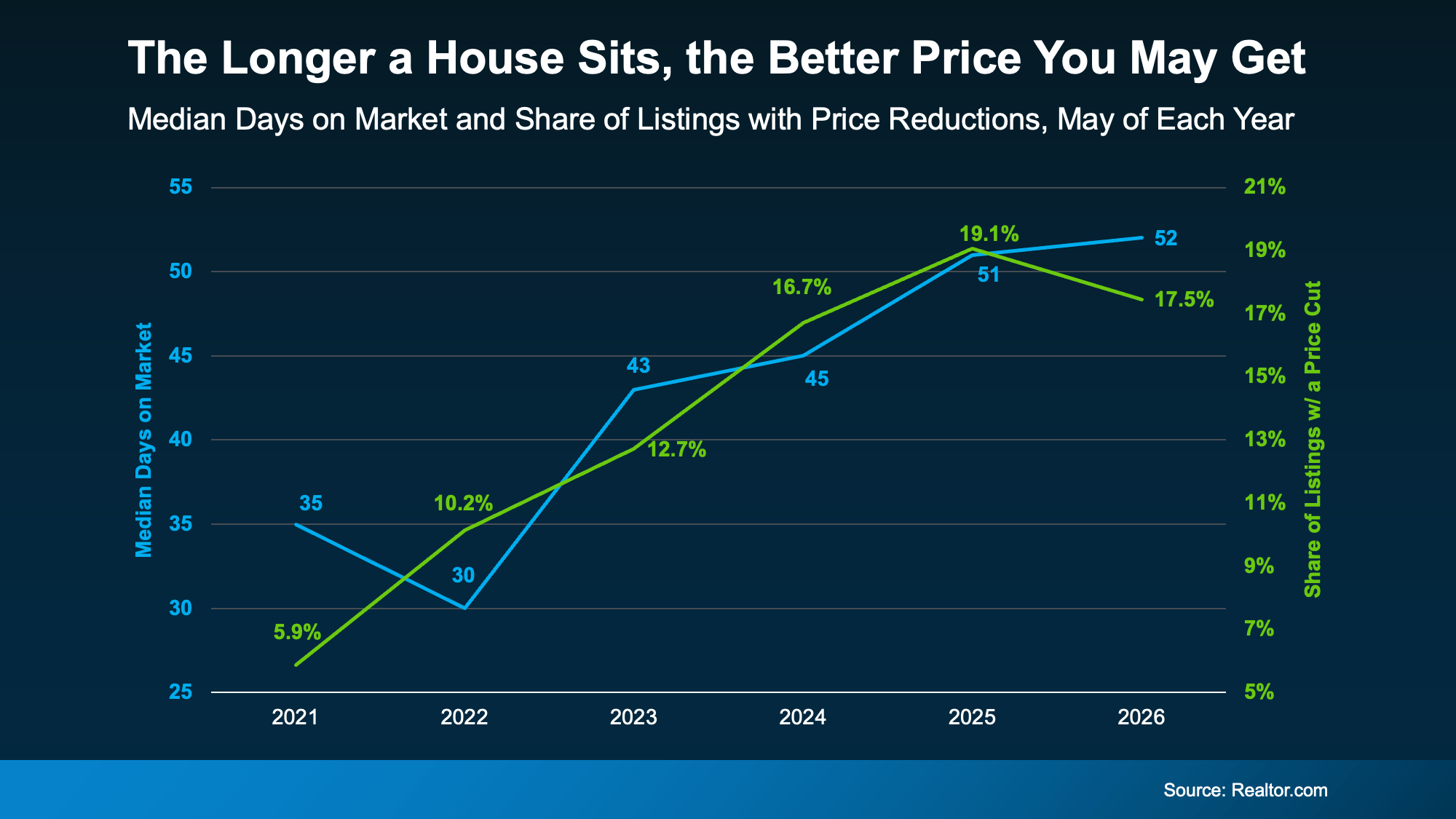
According to a Realtor.com report on pricing and time on market, homes that sell within the first four weeks close for about 1.8% more relative to asking price than the average sale. Homes still sitting at the 18-week mark close 1.3% below expectations. As Joel Berner, Senior Economist at Realtor.com, put it: an overpriced home doesn’t just sit, it gets stale, loses leverage, and ends up selling for less than it would have if it had been priced right from the start.
That mechanism is exactly what creates opportunity for buyers willing to look past the “something must be wrong” assumption. The longer a home sits, the more the math shifts in a buyer’s favor, and the more a seller’s motivation tends to grow.
There’s a Real Pool of These Homes Right Now
This isn’t a small or occasional phenomenon. Redfin data shows there is currently $347 billion worth of stale listings on the market, more than at any point on record for this time of year. That is a genuinely large pool of inventory sitting underneath the radar of most buyers, simply because most people search newest-to-oldest by habit.
If affordability has been your biggest obstacle, ask your agent to flip that search order and filter from oldest to newest instead. The home that fits your actual budget may already be sitting there, just further down the list than you’ve been looking.
Why Homes Actually Sit. It’s Rarely About the House Itself.
Before you write off a lingering listing, it’s worth understanding what typically causes a home to sit, because the reasons are usually about the listing, not the property. According to Redfin, the most common causes are an asking price that was set too high from the start, listing photos or an online presentation that didn’t show the home well, or simply too much competing inventory in the area at the time it was listed, which buried it in the search results.
None of those are dealbreakers. None of them mean anything is structurally wrong with the home. If there is a genuine issue, a thorough inspection will surface it, and that becomes information you can use in your negotiation rather than a reason to walk away before you’ve even looked. We covered exactly why overpricing in particular causes this exact pattern in The Pricing Mistake That Could Cost You Your Sale.
Two Levers You Actually Have Once You Find One
When you do find a lingering listing worth pursuing, USA Today outlines the two main levers available to you. The first is price. Work with your agent to pull genuinely comparable recent sales and build your offer around that data rather than the listing’s asking price. Coming in below ask is entirely fair game once a home has been sitting for weeks.
The second is concessions. If a seller has dug in on price, they may still have room to move elsewhere, covering a portion of your closing costs, offering repair credits for issues an inspection turns up, or even a mortgage rate buydown that lowers what you pay monthly. Our post on helping cover a buyer’s closing costs breaks down exactly when sellers are likely to say yes to that kind of request, which is useful context for shaping your ask.
This Strategy Depends Entirely on Knowing the Local Market
A lingering listing in a tight, low-inventory market means something very different than one in a market flush with options. We covered exactly why that distinction matters in Is It Still a Seller’s Market? Here’s What the Data Says. A house sitting for two months in a market with constrained supply is a much stronger signal of genuine opportunity than the same two months in a market already flooded with inventory, where almost everything is taking longer right now.
What This Means for Buyers Searching in South Jersey
Camden County’s overall market is still moving relatively fast, with homes going to pending in around 18 days according to Zillow, but that pace varies meaningfully block by block and price point by price point. A home that’s been sitting 60-plus days in a fast-moving market like ours is a stronger signal than it would be elsewhere, since it’s bucking the local trend for a reason worth understanding. Our Top Neighborhoods to Buy a Home in Camden County breaks down typical pace by community, so you have a real baseline to compare against when something has been sitting longer than expected.
If affordability has felt out of reach, this is one of the more practical strategies available right now, and it doesn’t require waiting for the broader market to change. It just requires looking at the listings everyone else is scrolling past.
Reach out to the MH Global team. Let’s pull the homes in your target area that have been sitting the longest and figure out which ones are genuine opportunities worth a second look.