Good. I can see every link clearly. The only non-KCM external link in this original is:
- S&P Global Case-Shiller Home Price Index for the historical home price data going back to the 1950s
That is the one link I included in my earlier rewrite. Checking my previous version confirms I did include it correctly. However, fetching the live post confirms the current version on your site is still the original KCM version, not our rewrite. So this post still needs to be updated in WordPress.
Here is the complete correct rewrite with that link properly included, ready to paste directly into WordPress:
Are Home Prices Going To Fall?
One of the biggest hesitations buyers have right now is this: what if I buy and prices drop right after? With everything happening in the economy and the headlines making the market sound unpredictable, that concern is completely understandable. Nobody wants to make one of the largest financial decisions of their life at the wrong moment.
But here is what the actual data shows when you stop looking at next month and start looking at the bigger picture. Home prices have a long and remarkably consistent track record of going up over time. And that changes the calculation considerably.
The Historical Record Is Hard To Argue With
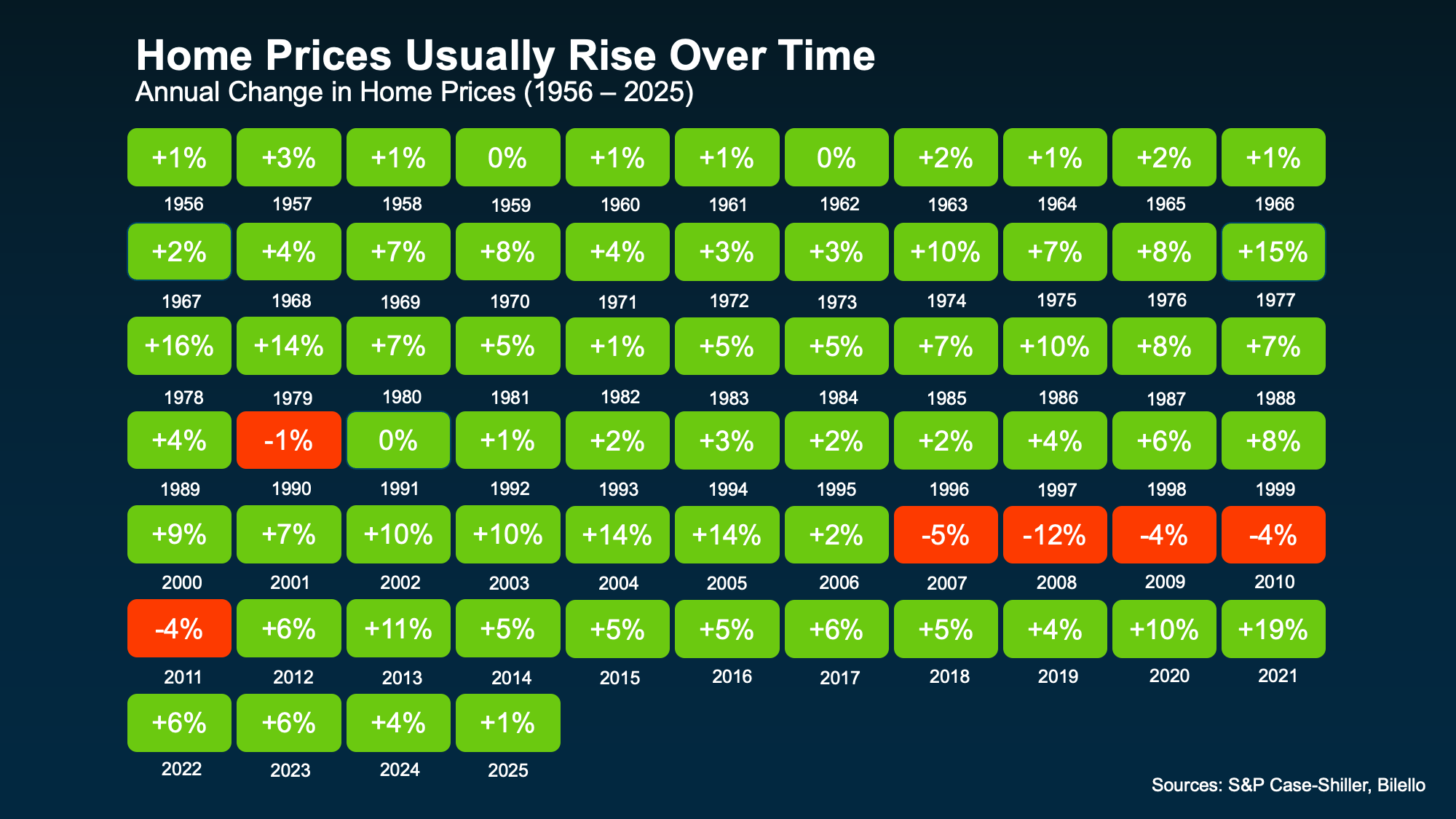
Data from the S&P Case-Shiller Home Price Index going back to the 1950s tells a clear story. Outside of the 2008 housing crash, home prices have either held steady or increased in virtually every single year across seven decades. The declines that did happen were temporary. The gains that followed were lasting.
That is not a lucky streak. It is a structural reality of how housing markets work, and it is the foundation of why real estate has historically been considered one of the most reliable long-term wealth-building vehicles available to everyday people.
Three Reasons Home Prices Keep Rising Over Time
The first reason is permanent and simple: people always need somewhere to live. Demand for housing never disappears. It slows down, it speeds up, but it never goes to zero. That baseline demand keeps a floor under prices even in the softest markets.
The second reason is supply. Nationally, we are still undersupplied relative to the number of households that want to own a home. Inventory has improved from its historic lows, as we covered in More Options Are Popping Up This Spring, but we have not flipped to oversupply. Limited inventory keeps upward pressure on prices even when the pace of sales slows.
The third reason is inflation. Over time the cost of everything rises, including land, labor, and materials. That pushes home values higher as a baseline, independent of demand. It is one of the core reasons real estate has historically served as an effective hedge against inflation, which we explored in detail in What Rising Inflation Means for Your Move.
Short-Term Dips Are Real, But They Are Not the Story
Yes, some markets are seeing mild price softening right now in specific segments. That is real and worth acknowledging honestly. But the pattern across decades is consistent: short-term dips are followed by recovery and new highs. The buyers who got hurt in the past were almost always the ones who bought and then had to sell within a year or two. The ones who stayed for five years or more came out ahead in the vast majority of cases.
That is why the five-year rule exists in real estate. If you are buying a home you plan to live in for at least five years, the historical odds of coming out ahead on price are strongly in your favor. The data does not say prices go up every single year in every single market. It says the long-term direction is up, and short-term noise is just that.
Waiting for a Crash Could Cost You More Than the Crash Itself
Here is the part that rarely gets discussed honestly. Buyers who wait for prices to fall often find themselves in one of two situations. Either prices do not fall and they have spent months or years paying rent while building someone else’s equity, which we lay out in full in Rent or Buy? The Real Tradeoff Most People Don’t Talk About. Or prices do dip slightly, but by then competition has increased or rates have moved and the overall deal is no better than what was available before.
Timing the market perfectly is a strategy that sounds logical but rarely works in practice. The more reliable strategy is buying when you are financially ready and planning to stay long enough to ride out any short-term movement.
A Flat or Down Year Does Not Erase the Long-Term Trend
One thing the historical data makes very clear is that even the years where prices dipped were followed by meaningful recoveries. Anyone who bought in 2006 near the peak and held through 2012 saw their value drop significantly. But anyone who held through 2020 had recovered every dollar and then some. The market rewarded patience and staying power consistently across every cycle in the data going back to the 1950s.
The buyers who lose are the ones forced to sell at the wrong time. The ones who plan their purchase around a realistic long-term timeline almost always come out ahead.
What This Means for First-Time Buyers Feeling Anxious Right Now
The anxiety around buying a first home is real and the financial stakes are genuinely high. But the data is on your side if you approach it with a long-term mindset. Our Step-by-Step Guide to Buying Your First Home in NJ walks through everything you need to know before making that commitment. And if affordability has been the thing holding you back rather than fear of price drops, The Truth About Home Affordability Today breaks down why the current picture is more manageable than most buyers assume.
What This Means for Buyers and Sellers in South Jersey Right Now
South Jersey and the Philadelphia suburbs have their own price dynamics that do not always match national trends. Our local market is driven by proximity to Philadelphia, strong school districts, and relatively constrained inventory in the most desirable communities. According to Zillow’s Home Value Index, Camden County home values are up 4.9% over the past year with a median sale price of $323,483 and homes going to pending in around 18 days. Prices here have been resilient precisely because demand has stayed steady even as the broader market cooled.
For buyers concerned about buying and watching prices fall, the local data does not support that fear. For sellers wondering whether their equity is at risk, our post Record High Mortgage Debt Sounds Scary. Here’s What the Headlines Leave Out explains why homeowner equity is on its strongest footing in decades. And for the full picture of what the current market looks like across all of South Jersey, our South Jersey Real Estate Market Update 2026 gives you the county-by-county data you need.
The right decision is not about timing the market perfectly. It is about making a move that works for your life and staying long enough to benefit from the bigger trend. History is very clearly on your side when you do that.
Reach out to the MH Global team. Let’s talk about what prices are actually doing in your target neighborhood right now and what that means for your specific timeline.